Jul 2, 2020

First Half 2020


I hope this finds you well.

The first half of 2020 is finally over and it certainly felt more like a decade than half a year. There was more activity politically, economically, and in the markets than in any six month period I can remember. It seems remarkable that a mere three months ago the market hit a new low, accentuated by a near record decline of 12% in a single day.  A mere four months ago we celebrated someone’s 20th birthday in style-that seems like two years ago.

After imploding in the first quarter, the markets staged one of the great comebacks in market history, rising over 20% in the second quarter to post one of the best quarters in decades. In spite of record declines in GDP combined with record spikes in unemployment, the market stands a mere 4% below where it started the year. There has been some interesting divergence as the NASDAQ has risen by over 12%, led by large cap technology stocks; the S&P 500 has declined 4%; the Dow Jones has declined 10%; and the MSCI All World Index has declined 7%.  For the first time in over decade there has been significant divergence in markets as the difference between winners and losers, which had been minuscule, is now defined by those which are thriving versus those facing severe stresses to their business. This should be the perfect environment for active stock management, however, once again managers are failing to outperform markets. We are early in this process and will monitor how it progresses.

The craziest economic reports are coming in the employment data. The change in non-farm payrolls plummeted by 1.3 million in March and a staggering 20.8 million in April.  The Federal Reserve provided massive monetary stimulus, and the Federal Government provided massive fiscal stimulus to help stave off even worse declines. The short term results seem to be moving in the right direction as May jobs increased by 2.7 million and 4.8 million June, reported this morning. The labor participation rate also rose from 60.8% to 61.5% in June. There is a concerning cliff in front of us as the excess unemployment benefits expire at the end of July and many states, such as our own, are making decisions to reduce the number of businesses being opened. While there is ample evidence that the five weeks of protests have an strong correlation to the location of viral hot-spots, government officials are still focused on restricting access to small businesses, outdoor celebrations that are not protests, and backyard BBQs. It seems that until officials choose to be intellectually honest that either ALL outdoor activities are a risk or NONE are a risk of viral transmission, people will ignore guidance because of the obvious contradictions and this virus will continue to vex us for an extended length of time.

The strong second quarter in the market, following a weak first quarter, is not without precedence. According to the table below, after a 15% or greater quarterly decline the market rises 70% of the time the following quarter. While the most recent 19.9% market return was not the biggest in history, you can see it was the biggest bounce in a quarter since 1938. 


Although valuation is a terrible timing tool, especially during economic or market inflection points, it is always a standard conversation that needs to be addressed. In the table below you will note that earnings estimates are declining as the economic slowdown continues (top panel). Given that stocks have rallied, valuations have risen (bottom panel). Note that this chart is relatively short term, since 2008, thus it makes the valuation jump look a bit extreme. If we were to consider the CAPE or other long-term valuation measures, the market does not look as overvalued.  Once again, valuation is a terrible timing tool for markets because it does not consider the direction of the economy, investor sentiment, fiscal and monetary policy, nor rates. I do not want to suggest valuation Is irrelevant, but today valuation is subservient to other factors.


Over the past decade we have witnessed enormous capital flowing into private equity. It is no secret that many managers have migrated from making money for their investors to fee generating machines benefiting the manager. As the past decade progressed, much has been made about the “dry powder” or available capital to PE firms to take advantage of a market dislocation.  What we are observing is that many of the larger fund managers with older vintages of funds are stepping in to help their existing portfolio companies with that dry powder. Newer managers and/or those without large legacy portfolios are well-positioned to take advantage of the developing opportunity set. As in most areas of investing, each manager is unique and over the next two-three years we should experience a large differentiation in performance between the managers. After extensive conversations with all of our managers, we feel that the bulk of the portfolio is in excellent shape to take advantage of this economic environment.


Education has been in the news lately.  Will schools open? Is the rapidly rising tuition worthwhile? Does the brand of school matter?  Strategas group recently analyzed the academic credentials of Chief Executive Officers of the Fortune 500 companies. Of the five-hundred, 23 had no college degree, thirteen were from the University of Wisconsin System, ten from Harvard, eight from  West Point/Penn/Texas A&M, seven from  Purdue, and six from Cornell/Iowa State/Michigan/Stanford. Among the 500, 110 held masters, 29 JDs and 15 PhDs. It appears that if you want to be a CEO, a degree is required, but there really is no advantage between schools. Personal qualities and skills matter more, supporting the meritocracy inherent in the capitalist system. In a nod to a friend, I’m still searching for the CEO from Cal State LA.


Have a wonderful Independence Day.

Ned

May 1, 2020

Good Morning

I hope this finds you and your family safe.

The markets rose over 10% in April, the first time in recorded history we have witnessed a double digit drop in one month followed by a double digit increase the next. The bounce in the markets has been fueled by the largess coming from the Fed, the federal government, and a peak in infection rates. As first quarter earnings reports begin to roll in, we are seeing the tip of the iceberg as to the economic damage done so far and that to come. GDP in the first quarter was down 4.8% (chart below), and is estimated to be down 30-50% in Q2. We experienced about four weeks of weakness in Q1, we will experience an entire quarter in Q2. The market seems to be pricing in a quick recovery in Q3, which seems unlikely given the amount of damage done to the economy, the progression of Covid-19, and the number of jobs lost (now 30 million and rising). With the market down just over 10% from its highs, it seems unlikely that we won't see another downturn in the markets as the damage becomes more apparent. As I stated a few weeks ago, I would happily be wrong on this outlook.


The average stock began recovering versus the big five (Microsoft, Apple, Google, Amazon and Facebook), with a 400 basis point performance spread between the equal-weight S&P and the traditional cap-weight S&P this week is among the most statistically extreme (99.9th percentile) ever recorded. Somewhat counter-intuitively, high beta stocks continue to outperform low beta. As an example, both the banks and semiconductors were strong while the Utilities traded to fresh 3-month relative lows. 

As the country slowly moves back to work, concerns about employees not wanting to return to work because of health worries and income will create a drag on the recovery. Some lower-paid workers on unemployment are actually making more right now than if they were to return because of the boosted benefits provided by the government. This program needs to be scaled down to encourage people back in the workforce when jobs become available. California, which continually sets a new bar for making itself unattractive for businesses, has added a caveat to the return to work rules allowing workers that "feel unsafe" to remain on unemployment. If these workers are terminated or otherwise retaliated against for refusing to go into work, they may file a retaliation claim with the Labor Commissioner's Office. Most states have announced plans to reopen in stages with schedules for select businesses, followed by restaurants, over the next few weeks. The notable exception is California, which seems to be moving in the opposite direction.

On the viral front, good news came from a Gilead trial for treating the virus. Patients who received Gilead's Remdesivir showed a recovery rate of 11 days versus 14 days for those on a placebo. The death rate for those on the drug was 8% versus 11% for those on the placebo. Remember that those in the hospital are among the sickest patients, and a comparable measure of influneza patients has a mortality rate around 10%.

All economic results have been weak, but personal pending declined by 7.5%. The drop in consumer spending has an outsized impact as consumer spending is roughly 2/3 of the US economy. The weakness in spending is exacerbated by a shift towards consumer staples such as food and toilet paper, which carry lower margins than consumer discretionary items. The resulting lower margin mix has put additional pressure on retailers, although delivery services such as Instacart have benefited.

State budgets will continue to come under pressure, especially in states with large unfunded pension obligations such as New York, New jersey, Illinois and California. Federal tax deposits were down 45% in April, a sign that states will also report a significant decline in their April taxes. The decline in tax revenue is due to an automatic 90-day extension of tax returns and filings, from April 15 to July 15.Watch for a surge in July, however, states will have difficulty filling the budget gap until that date.

After the first warm weekend of 2020, Governor Newsome imposed his version of Marshal Law on Orange County by shutting down the beaches. The Orange County Sheriff's office announced that they would not enforce the ban as they view it to be unconstitutional. The ban was catalyzed by doctored news photos of people at Newport Beach last weekend. The angle of the pictures used were taken at an angle that made the lifeguard towers in Newport appear to be about 30 yards apart and thus the crowds quite densely spaced. The aerial photos clearly showed the beach was sparsely populated, but the Governor, enjoying his newfound self-anointed dictatorial power, closed the beaches anyway. OK-political rant over ??

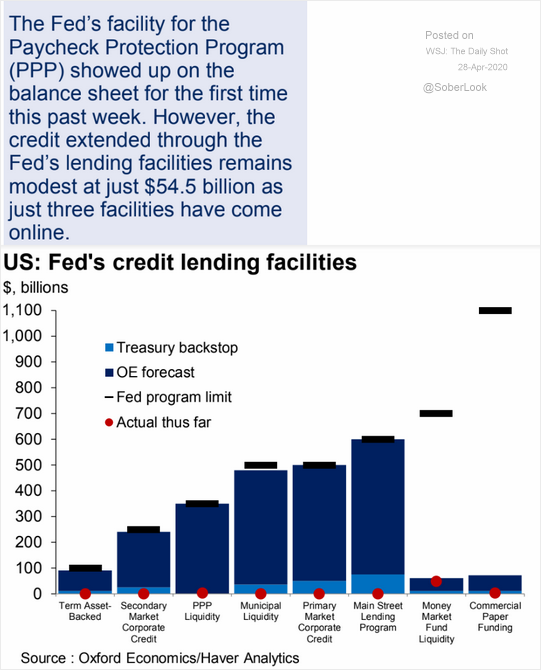
I have discussed the plethora of Fed programs designed to help the credit markets and employers. The table below is a summary of those programs and money put to work so far.


Food has been the largest expenditure for consumers over the past two months, making it difficult to acquires some categories of food such as meats. Recent closures of meat processing plants will add to the difficulty of obtaining meats.  The picture below shows a number of meat processing plant closures occurring in the past couple of weeks.  President Trump has stepped in to offer aid and technology to keep these businesses open.


Have a great weekend, hope to see you at the beach

Apr 23, 2020

Good morning

I hope this finds everyone safe and well. I've been working from home for over five weeks now and in addition to discovering how many gardeners work in my neighborhood, I reverted to a skill from high school and gave myself a haircut last weekend.  Video available upon request.

This morning's note is entitled "We've Never Seen…" because I am sure I have heard that phrase used to describe at least twenty different economic or market scenarios evolving during the past two months. This week we added another to the list as oil prices collapsed and went NEGATIVE!.  What does that mean?  On Monday, as the price of oil (WTI) collapsed to -$40 per barrel, as oil producers pulled a barrel of oil out of the ground, they had to pay someone else $40 to haul it away.  While that's a simplification as I expect a large speculator probably blew up, it shows the absolute carnage in the energy sector so far this year.  The chart below shows oil prices, adjusted for inflation, going back to 1870, 150 years. When we say "We've never seen..", this one takes the cake. 


As with any other asset class, this is not simply  a case of "price down, asset bad."  (Sorry that sounded like a GEICO Caveman commercial-bad tone comes with three hours of sleep). Energy, specifically oil, is a tough sector to make money because the overall economics for energy are bad. When you analyze the sector across an entire energy cycle, from glut to shortage and back, you have one of the few industries which does not earn its cost of capital.  What does that mean?  It means that for every dollar invested to develop a unit of energy, the return on that investment is negative. As an example, Exxon can arguably be considered the best operator among the major oil companies. Their cost of capital is 8%, which means they pay 8% to investors for every dollar they invest into the business. Their long term return on invested capital is 2%, which means for every dollar they invest, they earn 2%.  It doesn't take a math wizard to recognize that if Exxon's capital cost is 8% and their return on that capital is 2%, Exxon is losing 6% on every dollar they invest in their business.

How does the industry keep attracting capital with poor long term returns? Tax incentives are one enticement. The other is the overconfidence of investors, who are certain that 1) they can time the energy market, and 2) they can find the company in the space that will outperform. Item one, timing the market, is tough because the cycles are so long. The last great opportunity to invest in oil was 1998, when oil touched $10 per barrel (note that was the last time I was bullish on the space). The cycle was strong for roughly nine years, but has been in a morass since the GFC.  Item two, picking the best company, is truly folly in the energy sector. Long term analysis shows the correlation among energy stocks at 0.9, which effectively means you could throw a dart at the names in the sector and have a 90% probability of performing in line with market. In other words, stock picking in energy doesn't matter!

The question is what to do now that oil is in turmoil?  My short answer is stay away for now. I am going to speculate that oil won't touch -$40 again (note it's $17 today), however, the fundamentals today are worse than when the last big collapse started in the mid-1980's, a cycle that took 13 years to find its bottom, in October 1998. Demand destruction is occurring because of the Covid-19 situation, however, even prior to this crisis oil prices were collapsing. Note in the chart below that the price of crude in December 2019 was $61, and began falling well in advance of the shutdown. Global production was running ahead of demand, a situation that was exacerbated by a series of political events. President Trump sanctioned Russian oil company Rosneft for evading sanctions on Venezuela. OPEC plus, effectively OPEC members plus Russia, could not come to agreement on production cuts and Saudi Arabia and Russia entered a production war. While demand was collapsing, the 2nd and 3rd largest producers in the world ramped production. Saudi Arabia, Russia, and the United States now all produce roughly 11 million barrels of oil per day.


One of the three large producers is going to blink. Russia and Saudi Arabia do not get along and are happy to hurt each other, however, the United States energy sector is taking hard hits as a result. Because the other two are effectively government run and owned, they can be coordinated in their actions. In the United States, our energy market consists of scores of private energy companies and thus do not act in unison. Layoffs have begun in the sector, rig counts are declining. It would appear that, at least initially, the US energy sector will be the first to have capacity cutbacks.

Is this the type of cycle where a long term bottom is established and a resulting investment cycle will develop. I believe so, however, it will take a couple of years for the production destruction to occur and supply-demand to come back in balance.  Oil prices will continue to fluctuate, dependent upon market sentiment and announcements regarding production levels and demand. The long term supply/demand most likely will not come back into balance until sometime in late 2021 or 2022. This means that while we may have seen a bottom in oil prices, there are many bankruptcies, production shutdowns, and acquisitions coming to rationalize the production  capacity.

The upshot is gas prices should remain low for some time, hopefully we will all be back in our cars soon to benefit. I haven't filled my car since March 7th but am looking forward to paying $2 for a gallon of gas. 

Have a great day

Ned

Apr 10, 2020

We Have No Clue

"To date we have no clue how many people have been infected. This could be an extraordinarily important piece of how we're going to get over this epidemic." Eran Bendavid, infectious disease physician, Stanford University
While the world is full of unknowns and the future is unpredictable, hearing these words uttered from a leading infectious disease specialist certainly makes you question our chosen course of response to Covid-19. Have we taken appropriate steps by shutting down 50% of the economy? Did we go overboard in our response? Is the recent CDC estimate of 60,000 US deaths, down from 240,000-2,000,000 just two weeks ago, a signal that our extreme efforts are working or that the panic was overblown? I will repeat the comment from the Stanford physician "we have no clue."

Regardless of my opinion on the necessity of the extreme shutdown of the economy, there is no disputing that the impact is unprecedented and enormous. Except during war, shutting down the economy by government fiat in a free society has never been attempted before. Making these types of decisions without sufficient data to appropriately understand the risk of not acting, and without any way to objectively measure the success or failure of the policy, is fraught with risk. The biggest risk has been the excessive insertion of opinion versus fact in the decision-making process, the politicization of the situation, the reckless abandon of the press to fuel the panic, and the decision to implode the economy without a true understanding of the risk of a more limited response.

The chart below, courtesy of Blackrock, shows their estimated trajectory of the economic impact compared to the Great Financial Crisis (GFC) of 2008.  Note the severity of the initial downturn today versus 2008. Also, it is important to note the size and speed of the policy response. In 2008 the response from the Fed and the government was measured, haphazard (think Cars for Clunkers as an example), and slow. The response from the Fed has been significant in size, speed and breadth. My best estimate is that Fed programs could ultimately total $10 trillion. Recall in the GFC the Fed balance sheets expanded by just over $4 trillion. Adding some perspective, the US economy is $22 trillion annually. These are BIG programs.


The chart below, from the Federal Reserve of St. Louis (FRED), demonstrates how quickly the Fed has expanded their balance sheet, with more programs on the horizon.


The response from the federal government has also been swift, comprehensive and sizable. In addition to responding to the healthcare issues resulting from the crisis and the normal today to day operations of the government, the federal government is also creating processes on the fly to deliver the promised funding to those in need.  This is a daunting task and will test the patience of recipients who want their money yesterday, but also will test the organization and systems of a government which is not known for its efficiency.
Some have posited this will lead to another depression. While the possibility cannot be completely eliminated, the probability is very small based upon what we know. The fiscal and monetary response from the Fed and the government during the Depression exacerbated and extended the downturn, turning a liquidity crisis and recession into a solvency crisis and depression. The policy responses during this crisis stand in stark contrast to those of the Great Depression and minimizes the possibility of depression.

How far will GDP fall?  I have seen estimates as high as 50% declines for the second quarter and 10% for the entirety of 2020. The chart below, courtesy BoA and the BEA, shows the declines in GDP during previous recessions dating back to 1953. Note that the worst case scenario of 2020 is estimated to be the largest we have seen in that time period, however, the policy responses combined with consumer balance sheets that were strong heading into the crisis, should help reverse this downturn through the course of 2020, assuming we do not experience a significant second wave of Covid in the fall. My estimate for 2020 GDP is in the -4-5% range.


Always the question becomes, what does this mean for markets? The markets have rallied from the most recent bottom as the government programs have been approved, but also as estimates for the severity of Covid-19 have subsided-the now proverbial "flattening of the curve." Have we seen the bottom in markets?  My hope is yes, but history and logic say probably not. In addition to the 16 million new unemployment filings over the past three weeks, with more to come, there is a slew of bad economic data coming over the next couple of months which could add downward pressure on the market. The horrific set of earnings reports coming soon, the bankruptcies of well-known companies, ongoing bad economic data, a negative turn in the Covid battle, bad news from foreign markets, and history could all signal a bottom is still coming. Some of that is already priced into the markets, but it is questionable whether markets have truly priced in the full extent of the damage being done to the economy. Some factors that could support the market include a quicker economic recovery, effectiveness of the government programs being implemented, size of the Fed response, and progress on the virus front (better testing, lower mortality rates than initial estimates, a vaccine, effective anti-virals, etc).

I have had multiple conversations with virtually all of our managers over the past eight weeks, with a focus on identifying any trouble spots as well as where opportunities exist. Fortunately, we have had minimal surprises in the portfolio. Opportunities in the credit space abound and we are fortunate to be involved with some very skilled managers in this area who successfully navigated the GFC and are well-positioned to excel in this crisis as well.

This is a holy week with Passover and Easter. Take time to enjoy your blessings and family.  Happy holiday to all.
Cheers

Ned 

Mar 27, 2020

The Bear Market

Good Morning

Another day, another 3% + move in the markets.  This is starting to feel normal. After falling into a bear market faster than any time in history, the market just posted one of its strongest weekly rebounds ever. The questions I began receiving yesterday afternoon can be summarized in one short line "is the Bear Market over?" In my view the answer is "not yet."  History, fundamentals, and that very dangerous emotion known as "feelings" are on my side.

The history of bear markets suggest that a quick resolution of the bear is extremely rare, if ever. Bear market rallies can be powerful, as we saw this week. In my view, the goal of the bear market is to break the spirit of investors, both long and short. These powerful rallies tend to squeeze out the short sellers, providing fuel to the upward move, then breaks their hearts as it returns to the downtrend. We only need to look at 2008 for an example of this action. The fuzzy chart below shows three robust rallies of 24%, 19%, and 27% in October, November, and from Thanksgiving to Christmas of 2008. The market ultimately bottomed three months later, which felt like an eternity.


While markets tend to trade ahead of changes in the fundamentals, we are just at the beginning of the slowdown. We have virtually zero idea what the impact on earnings will be from these quarantines, so any earnings estimate is nothing more than a guess. Yesterday we saw the first snippet of bad news as the unemployment report jumped by 3 million, a record. Given 12 million people work in the food services industry and 17 million in the hospitality services industry, I expect those unemployment numbers continue to spike. It does appear the fiscal stimulus package could pass as early as today, but the question then becomes "how long will it take to get into consumer hands" and "what type of impact will it have."  The answer to the first question is "never soon enough," while the answer to the second question is "it depends." What does it depend upon?  The length and infection rate of this virus and how long the shut-in-place response lasts.

The last reason I doubt the bear is over is my "feeling," which is ironic given that just yesterday, in an interview with Reuters, I gave this quote: "The most dangerous three phrases in our business are  'this time is different'  'I feel as though…' and  'I hope' .  It's never different, your feelings are wrong, and hope isn't an investment strategy."  The consensus seems to be we haven't yet seen the bottom, which makes me immediately concerned as I try to avoid being in the consensus, however, this time I FEEL as though the consensus may be correct, although I HOPE they are not.

I have been through a number of bear markets and will posit that we will do some things right, and will definitely do some things wrong during this period. It's part of the business at all times, unfortunately the errors get magnified during a bear market. Everyone is smart in a bull market, everyone is dumb in a bear market. The most important part of navigating a bear market is not to dwell on the mistakes-NO ONE navigates through this perfectly. Perfection is the enemy of success in a bear market. Regret minimization is the key to mental stability and successfully coming out of a bear market. Don't dwell on the mistakes, it will keep you from executing your plan.

This too shall end. 

Have a great weekend

Ned

Mar 19, 2020

Every Note is About Corona Virus


This morning I was fortunate to be able to participate in a call with former Homeland Security Chief Michael Chertoff and former Director of Operations for the CIA Chad Sweet.  Their knowledge on pandemic preparation, security, etc, is invaluable.  I want to pass along some of the important pieces of information from that call.  Additionally, I have spoken with many of our managers over the past two days and was on an investment committee call with 12 CIOs and will include anecdotes from those calls as well. 

Needless to say we are in uncharted territory. There has never been a shutdown of the US economy with this breadth. Undoubtedly we will have a monstrously negative 2nd quarter GDP.  That is somewhat priced into markets today. The question is the duration of the slowdown and the speed of recovery.  The pace of the virus will be key to determining these trajectories, Michael and Chad addressed that issue.  The government reaction has been swift and robust. If the virus impact is relatively short, the economy should explode in 2021, the markets sooner.

Chertoff and Sweet:
1. This emergency is similar to a bioterrorism attack. The government has prepped for this type of attack for since 9/11.  The difference is there is no mass evacuation required and no infrastructure rebuild to follow.
2. The key to a successful path through this epidemic is clear directions and people following the prescribed rules. Social distancing, working at home when feasible, etc, will reduce the strain on our medical system.
3. The US has 1 million hospital beds but only 10,000 respirators. If the infection rate gets large, it will overwhelm the healthcare system and doctors will be placed in the unenviable  position of deciding who gets to use the ventilator.  The social limitations should help reduce the number of severe cases, which they feel is more important to the healthcare system than the mortality rate. Long term ill patients consume medical resources for long time periods. Not to sound cold, but dead patients don't consumer resources.
4. Weather should definitely slow this virus down, possibly ending the infection process by mid-summer. The travel ban to China and other actions helped stave off the onset of the virus in the US, which will work to our benefit as we are one-month closer to summer than a country like Italy.
5. Unless there are changes in the overly bureaucratic FDA, it would be 12-18 months for a vaccine. This becomes dangerous if the virus reemerges in September, much like the Spanish Flu of 2018. The majority of deaths from that pandemic occurred in the second season.   The impetus for the FDA to act judiciously has never been higher.
6. Their view is that the mortality rate is only slightly higher than that of the flu. The bigger issue is the percentage of serious cases requiring hospitalization (morbidity rate), which exacerbates the healthcare resource problem discussed earlier. They feel this percentage could be as high as 10%.
7. The media is dropping the ball, contributing excessively to the hysteria by reporting snippets of data such as a 52 year old dying from the virus. This out of context reporting misinforms  the public (but it helps ratings).
8. The Administration's early mistake was not their reaction, but their expectation that the virus could be eradicated and that would be victory. They have now appropriately shifted their expectations that victory is slowing the spread so as not to overwhelm our healthcare resources. Under that scenario, April 15 and May 15 are key dates for measuring the retransmission and growth rates. If the number of cases has stopped doubling by those dates, the virus should "burn itself out"  If we haven't achieved knocking the growth rate below 100% by then, we run the risk of this coming back as a full blown pandemic in the fall.
9. Outside of the early messaging mistakes, the financial and medical response from government has been on track  and for the most part textbook.
10. South Korea's success is due to their 70 years of being in a state of war. They practice and have stockpiled supplies in the event of a chemical or germ warfare attack from the North for the past 70 years.
11. If the number of infections tracks too far up and will overwhelm the number of beds available, the government will have to lower their standard of care and open college dorms, hotels, and parking lots for care centers.
12. The virus won't be rendered  completely gone until either a vaccine or exposure to the virus infects the majority of the population.
13. China's reports of no more cases are BS.  China consistently lies about their activities.  Additionally, people are loathe to self-report this illness because the government will yank them out of their homes, along with their family, and isolate them.

Regarding our portfolio, I have been on calls with our PE managers. Our allocations to distressed managers (XXX and XXX) should benefit from this environment.  Additionally, based upon the investment committee call I was on earlier today, it appears our secondary investments with XXX should also benefit as CIOs are concerned about liquidity and are looking to sell selective PE interests. I have also been on the phone with XXX XXX at XXX-at this time they are flush with dry powder and only have one portfolio company to worry about which means, unlike other managers with larger portfolios, they can focus on using their cash for opportunistic purchases versus shoring up existing portfolio companies.

For our overall portfolio we have quite a bit of cash and will use it strategically but patiently as this situation will not be resolved in the next two weeks. We should be thinking in terms of months, with a mid-late June time frame being realistic and a success.

Have a great day

Mar 12, 2020

Corona-Virus Economic Impact


I typically like to write on Fridays, however, given how rapidly the economic conditions are deteriorating (along with the markets) as the hysteria spikes, this morning seems like a good time to send out some thoughts.

First, the virus. According to the CDC, 80% of people will experience cold or flu-like symptoms if they contract the virus. The remaining 10-14% will experience more severe symptoms and of those, 10-14% will experience critical symptoms. For those not following the math, 1-2% of those contracting the virus will experience critical symptoms. The United States has 1233 cases of Covid-19 as of this morning and 37 deaths. To put these figures in perspective, H1N1 in 2009 killed 280,000  and this year’s flu has killed 45,000. If you are older than 65 or have underlying health issues, especially lung related, you are in the higher risk group.

The NBA has postponed the remainder of their season. The NCAA has announced March Madness is now cancelled. Conferences and travel have been cancelled or dramatically curtailed. Major banks, Google, Twitter, and scores of other companies are having their employees work from home. Universities, including Ole Miss where my son attends, have cancelled ground classes and are moving online (BTW-my son gets an extra week of spring break while they figure this out, he's quite excited). Costco is out of toilet paper (I love that one and don’t quite get it). Without proper perspective and guidance, organizations are taking draconian measures and it’s having a major effect on the economy.   

Why is this occurring? Fear and misinformation. This is the first epidemic to occur during the social media age. The majority of Gen Z and Millennials do not subscribe to cable television. Most of their news comes from social media-Facebook, Twitter, Instagram, etc. As Abraham Lincoln once said “The problem with stealing quotes off the internet is you never know if they are genuine.” I have friends on Facebook who were constitutional scholars in January during the impeachment and are now global virologists. The point being, too many people are taking their cues from social media, and given the vacuum of leadership from the White House, the reaction has taken on a life of its own.

Although the virus has not made significant progress in the United States so far, the reaction is having a severe impact on the economy. Two weeks ago my recession probability jumped to 60%, today it’s at 90%. The impact on the hospitality, travel and entertainment business is breathtaking and this alone will have a ripple effect through the rest of the economy as these workers become either underemployed or unemployed. Retail is being impacted as shoppers avoid malls, yet crowd into Wal Mart and Costco to stock up on staples.

I’m anticipating a weak set of earnings for the first quarter, with significantly lower guidance (or no guidance) from companies for the second quarter and the remainder of 2020. A few companies may benefit during this period-some healthcare companies, Amazon (when you’re shut in, someone needs to deliver), Facebook/Google/Twitter/Netflix (as people stay home, they need something to do), Apple (device sales will be soft, but the higher margin services business should benefit), Zoom and WebEx (video conferencing), Grand Canyon (online education), etc. The majority of companies will suffer, especially those which are consumer facing.

Given our large cash position coming into February (17%), we are looking for a spot to put capital back to work. Given the speed at which the economy is deteriorating, and the market along with it, we are being cautious  but systematic. The fear factor is high in the market as evidenced by the VIX, which has spiked to 67 this morning, not far from a record high. Given the 25% correction in the stock market, this isn’t a horrible time to add to equities. The question is whether this will be a 4-6 week economic shutdown or a 4-6 month shutdown. If the former, the market has probably seen it’s worst moments. If the latter, we have another 10-15% to fall. For those looking for spots, legging into the markets makes sense and if you haven’t already done so, your first tranche should be now.

The federal government is discussing a number of ideas on the fiscal front to help stimulate the economy. In my view their efforts won’t be helpful in the short run without creating confidence that the virus is under control.  What could create a quick turnaround in the economy?  A government sponsored, mass testing program for the virus would be significant. Those with the virus could self-quarantine, those without could go back to their regular routine.

The Fed is active and will become more active as certain credit markets become impaired. (in fact, after I wrote this, the Fed added $500 billion in asset purchases) With a few exceptions, the markets have been functioning smoothly in spite of the mass selling. High yield spreads have spiked, BBB credit has collapsed, and treasuries have rallied-all normal responses for a slowing economy.

I’m happy to answer any questions. This is a fluid situation that we are monitoring closely. As an example, I have been reading hourly updates from the CDC to keep up with their latest thinking on the progress of the virus-now I’m a global virologist 😊

Have a great day and weekend.

Ned

Nov 12, 2019

Why Income Redistribution Fails

Elizabeth Warren has proposed economic "plans" to effectively take the assets of one group of citizens and give them to another. Many think she is giving those stolen assets to those in need, but instead they will go into the pockets of government, swelling the public sector at the expense of the private sector.

The note below is a simple parable from Brian Westbury highlighting the folly in Warren's idea.  Enjoy.


Income Inequality, Taxation, and Redistribution

One of our favorite economic parables is the Fish Story, from Paul Zane Pilzer’s 1990 book, “Unlimited Wealth.”  It is an excellent tool for thinking about wealth creation, inequality and redistribution.
 
Imagine 10 people live on an island.  Each day they wake up, catch two fish, eat them, and go back to bed.  Its subsistence living at the most basic level.  There are no savings – no stored or saved wealth.  If someone gets sick and can’t fish, there’s no way to help them.  No one has any extra.

Now imagine two of these people dream up a boat and a net.  They spend six days catching one fish per day, slowly starving, but they make the boat and net.  On the 7th day, they go out into the ocean and catch 20 fish in the net – it worked!!!!

At this point, the island can go one of two ways.  First, since two people now produce what previously took ten, resources are freed up to do other things.  Farming corn, picking coconuts, cleaning fish, cooking, repairing the boat and net, the possibilities are endless.  The island ends up with more (and better!) food, new technologies, higher standards of living, more assets, more wealth, and they can now afford to take care of their sick and vulnerable!

Or…the eight people who don’t have a boat and net could become envious.  Two now produce ten fish per day, while everyone else can only produce two.   Income inequality now exists:  it’s no longer 1:1, it’s 5:1.  So, they devise a plan to tax 80% of the income of the boaters (16 fish) and redistribute two fish to each of the other inhabitants.

If the second plan is adopted, no one is better off.  Each inhabitant still only has two fish.  Moreover, the entrepreneurs have no incentive to fix their boat and net.  The island will eventually revert to subsistence.

This is the problem with taxation for redistribution: it robs the economy of the benefits of new technology.  Certainly, some of our brothers and sisters need help, sometimes permanently; sometimes temporarily.  However, taxation for redistribution doesn’t make the economy stronger; redistribution hurts growth.

Everyone on the island is better off because of the boat and the net.  Taxing the inventors’ wealth or income and redistributing it removes resources from a highly productive new technology.  Moreover, the income inequality that exists on the island is a sign of more opportunity, not less.

There are things the government can do that add to productivity – police and fire protection, national defense, enforcing the rule of law and protecting private property – but once government goes beyond this, it begins to undermine growth.

Today, 17% of all personal income is redistributed by government, while around 40% of all income is taxed and spent by the federal, state and local governments, combined.  This is the reason the US economy has not attained 4% real GDP growth.  European economies tax and spend even more and this is why they have grown slower than the US in recent decades.

In the meantime, government leaders around the world blame slow growth on a lack of investment by companies and attempt unsuccessfully to use negative interest rates to stimulate lending and investment.  They also propose even more government spending and redistribution to help those that big government is holding back.

These policies won’t boost growth, and proposals to tax wealth and income because of the perceived problem of income inequality will ultimately reduce living standards.  Increasing living standards requires less government, not more.

Brian S. Wesbury - Chief Economist
Robert Stein, CFA – Deputy Chief Economist    

Jul 11, 2019

Summary of the Democratic Party Platform

The first Democratic debate was quite the "promise-fest", with candidates one-upping each other with promises of more goodies for We the People.  In today's Wall Street Journal, Karl Rove compiled a summary of the promises and crafted it into a potential speech for the Democratic nominee for President. Enjoy! 

“Trump is a phony, a pathological liar and a racist. He’s the divider in chief, the bully I’ve known my whole life. To him, white supremacists are ordinary, decent people. It is now time to restore the nation’s soul. This president has ripped it out.
“Our economy is rigged for corporations and the very wealthiest. It does great for a thinner and thinner slice at the top, for giant drug companies and oil companies, but isn’t great for everyone else. That is corruption, pure and simple. Nothing will change unless we take on Wall Street, the big pharmaceutical firms, the military-industrial complex, the fossil-fuel industry and big-money interests and make structural changes to our government, economy and country.
“Health care is a basic human right—and it’s worth fighting for. The best way to provide it is Medicare for All. If that means abolishing private health insurance in favor of a government-run plan, so be it. There are too many people profiteering off America’s pain, from drug companies to insurers to hospitals. Moreover, we do ourselves no favor by having 11 million undocumented people in America without health-care coverage.
“It’s also time to repeal the Hyde Amendment, which forbids using taxpayer dollars for abortions. I can’t justify leaving millions of women who are dependent on government support without a way to lawfully access abortions. And let’s not forget that if a trans woman is poor, that doesn’t mean she shouldn’t have the right to an abortion.
“We can no longer ignore the existential threat of climate change. We have to confront it before it’s too late. Scientists tell us we have only 12 years before there’s irreparable damage to our planet. That is why I support a Green New Deal to transform how we treat the environment, taking the world away from fossil fuels and toward energy efficiency and sustainable energy.
“We need to commit to free college for all our children. College shouldn’t just be a privilege for those who can afford it. We must make public colleges and universities tuition-free and eliminate all $1.6 trillion in outstanding student debt. We owe it to our young people.
“We can afford these changes. I would start erasing America’s enormous income inequality by eliminating Trump’s tax cuts for the wealthy. We can pay for free health care and college by putting a speculation tax on every stock trade on Wall Street. I’m tired of freeloading billionaires. There should be a 2% annual tax on household wealth in excess of $50 million and a 3% tax on every dollar above $1 billion.”
“I’ve been asked, would I put any limits on abortion? I would make certain that every woman has access to the full range of reproductive services. That includes birth control, abortion—everything a woman might need. Judges must be 100% clear that they will defend Roe v. Wade or I won’t appoint them. That’s my litmus test. To defend Roe, we may have to add Supreme Court justices—expand the court’s numbers by five to 10 or have a rotating pool of justices. I’m taking nothing off the table.
Let's hope none of the policies come to fruition or the economic outlook for the US will be similar to that of Europe-which is awful. 

Cheers

Ned  

Feb 9, 2018

I’ve had two questions all week that are predictable when markets decline.  Why is the market down?  When will it stop?  Interestingly, I rarely get asked the opposite questions when markets are going up.

There are rarely single reasons we can point to that drive markets down.  I realize on CNBC and Twitter they try to boil market corrections down to sound bites, but that’s for media consumption, not investors.  Their comments typically contain a truism, but rarely is it useful other than satisfying the mammalian brain’s need to categorize and rationalize fears.  In reality there are hundreds, if not thousands of conditions which can contribute to a downturn, most of which were probably in place during the upturn.  What changed?  Maybe sentiment.  Maybe a computer algorithm.  Maybe just time. 

After 30+ years I can only remember two instances where a single event drove the market down-September 11 and Long Term Capital Management.  I’m sure there are a handful of others, but hopefully that makes the point there isn’t a single catalyst, but a series of conditions that contribute to a market correction.

When will it stop?  Someone will get it right by predicting a point when selling will stop, and it will be more luck than skill.  When we are down 10%.  When the S&P hits 2550.  When volatility spikes to 50. When cows fly.  Again, it stops when the collective of market participants feels there are bargains, that their portfolios are rebalanced sufficiently, and it’s safe to go back into the market.  Finding or calling a single point, whether it’s a market top or bottom, is certainly the folly of fools. I have yet to see a system that is accurate at calling tops and bottoms.  Many market prognosticators have successfully called tops or bottoms, however, if you look at their records it typically occurs that they held their bullish or bearish stance for years, missing the market moves prior to their call.  In essence they have benefitted from the stopped clock syndrome-a stopped clock is right twice a day.

The chart below shows the S&P 500 over the past five years.  This correction is noticeable, however, we have had an extraordinarily long run in the market.  The unusual action isn’t the decline we’re experiencing, the unusual action is the run from March 2016 until two weeks ago, a time period we didn’t experience a single significant correction.  As I wrote last Friday, I would expect a series of 5% corrections and that we were long overdue for a 10% correction.  Prescient?  That’s doubtful, just lucky timing.  I was the stopped watch last week.


This past week is what a 10% correction feels like.  For any of us, if you feel as though this is too much volatility for you and are uncomfortable with what has happened in your portfolio, it is certainly time to reexamine your asset allocation and de-risk your portfolio a bit.  If you are sleeping well or not concerned a bit, you may want to dial up the risk just a bit.  If you’re comfortable with a small bit of anxiety, your allocation is probably just right.

I am happy to discuss any of the reasons that the markets have been down recently, please feel free to email or call.

Have a great weekend


Ned 

Dec 14, 2016

New York Times Slams "Liberal Bubble" Safe Spaces Across America's College Campuses


I haven't published a lot over the past couple of years, but my post-election note on Millennials seemed to strike a chord with people and was picked up by a couple of newspapers and many websites.  Following up on that note's theme, I ran into this op-ed in the NY Times, written by Nicholas Kristof, a Pulitzer Price winning author and self-anointed liberal.  I found it quite instructive as to liberal viewpoints and also refreshingly introspective-something we don't see from the liberal media or advocacy groups.  

I hope you enjoy it. 


After Donald Trump’s election, some universities echoed with primal howls. Faculty members canceled classes for weeping, terrified students who asked: How could this possibly be happening?
I share apprehensions about President-elect Trump, but I also fear the reaction was evidence of how insular universities have become. When students inhabit liberal bubbles, they’re not learning much about their own country. To be fully educated, students should encounter not only Plato, but also Republicans.
We liberals are adept at pointing out the hypocrisies of Trump, but we should also address our own hypocrisy in terrain we govern, such as most universities: Too often, we embrace diversity of all kinds except for ideological. Repeated studies have found that about 10 percent of professors in the social sciences or the humanities are Republicans.
We champion tolerance, except for conservatives and evangelical Christians. We want to be inclusive of people who don’t look like us — so long as they think like us.
I fear that liberal outrage at Trump’s presidency will exacerbate the problem of liberal echo chambers, by creating a more hostile environment for conservatives and evangelicals. Already, the lack of ideological diversity on campuses is a disservice to the students and to liberalism itself, with liberalism collapsing on some campuses into self-parody.
At Oberlin College soon after the election, students erupted in protests after a local bakery was accused of racial profiling of a black student in a shoplifting case. The student senate endorsed a boycott of the bakery, and demonstrators carried signs calling the owner a racist.
But allegations of a pattern of racist behavior were undermined by police records showing the overwhelming share of people detained for shoplifting at the bakery were white. This may actually have been a case of liberal hysteria.
Some of you are saying that it’s O.K. to be intolerant of intolerance, to discriminate against bigots who acquiesce in Trump’s record of racism and misogyny. By all means, stand up to the bigots. But do we really want to caricature half of Americans, some of whom voted for President Obama twice, as racist bigots? Maybe if we knew more Trump voters we’d be less inclined to stereotype them.
Whatever our politics, inhabiting a bubble makes us more shrill. Cass Sunstein, a Harvard professor, conducted a fascinating study of how groupthink shapes federal judges when they are randomly assigned to three-judge panels.
When liberal judges happened to be temporarily put on a panel with other liberals, they usually swung leftward. Conversely, conservative judges usually moved rightward when randomly grouped with other conservatives.
It’s the judicial equivalent of a mob mentality. And if this happens to judges, imagine what happens to you and me.
Sunstein, a liberal and a Democrat who worked in the Obama administration, concluded that the best judicial decisions arose from divided panels, where judges had to confront counterarguments.
Yet universities are often the equivalent of three-judge liberal panels, and the traditional Democratic dominance has greatly increasedsince the mid-1990s — apparently because of a combination of discrimination and self-selection. Half of academics in some fields said in a survey that they would discriminate in hiring decisions against an evangelical.
The weakest argument against intellectual diversity is that conservatives or evangelicals have nothing to add to the conversation. “The idea that conservative ideas are dumb is so preposterous that you have to live in an echo chamber to think of it,” Sunstein told me.
Of course, we shouldn’t empower racists and misogynists on campuses. But whatever some liberals think, “conservative” and “bigot” are not synonyms.
One of America’s most eminent scientists is Francis Collins, an evangelical Christian who is director of the National Institutes of Health. Few scholars had as much impact on modern thought as Gary Becker, the conservative University of Chicago economist. Condoleezza Rice, a secretary of state for George W. Bush, would add value to any campus.
I’m not arguing for affirmative action for conservatives — partly because conservative academics say they don’t want preferences. But I do think we can try harder to recruit job applicants who represent diverse views, to bring conservative speakers to campuses and to avoid a hostile work environment for conservatives and evangelicals.
We’re seeing an uptick in hate crimes in society tied to Trump’s rise, and the last thing we need on campuses is reciprocal illiberalism, this time led by liberals.
As individuals, we can also follow smart people on social media whom we disagree with. In my latest email newsletter, I suggest some conservatives to follow.
I fear the damage a Trump administration will do, from health care to foreign policy. But this election also underscores that we were out of touch with much of America, and we will fight back more effectively if we are less isolated.
When universities are echo chambers, they become conservative punch lines, and liberal hand-wringing may be one reason Trump’s popularity has jumped since his election.
It’s ineffably sad that today “that’s academic” often means “that’s irrelevant.” One step to correcting that is for us liberals to embrace the diversity we supposedly champion.

Nov 10, 2016

Millennials to America "Where's My Participation Trophy?"

Today's note isn't really about the election outcome except to say that I have been unhappy with our Presidents for a generation, so for those who aren't happy with this one, get over it.  This too shall pass.  

Personally I'm cautiously optimistic that a non-affiliated moderate President sympathetic to business needs combined with a Republican House and Senate could end the eight year dismantling of the business friendly country we live in and begin the rejuvenation of the middle class.

Now, for today's topic.  I was involved in a group chat yesterday with my nephew and son, discussing the election.  They are both millennial college students, one at Oregon and one at St. John's, neither bastions of conservatism.  They were both very pro-Trump, obviously making them outliers on their respective campuses.  Both are athletes at their school, which will be relevant to this story.  

They were both relaying the despair that was spreading across their campuses as students were crying and agonizing over the election results.  I was in shock hearing what they had to say about their classmates' reaction.  I will save the story about my nephew being kicked out of an anti-Trump rally for another day.

As I read news reports on the election, my attention became gripped on the reactions across college campuses. I wasn't so much interested in the protests, but instead the response of administrators and professors.  These headlines almost made milk come out of my nose:
Colleges Try to Comfort Students Upset by Trump Victory
Despair over Clinton's Loss Prompts "Cry-in" at Cornell
 Play-doh for the Distraught
 University of Illinois Sets up Safe Spaces for Precious Snowflakes
 Trumpophobia Melts Snowflakes
 Then I read about a Yale professor cancelling a mid-term because of students being distraught.  Students at the University of Michigan playing with Play-Doh and coloring in coloring books in an effort to self-sooth. The President of that same university saying it will take "quite some time to completely absorb the results".  St. John's having a town hall to discuss peoples "feelings" about the election.  I even heard unconfirmed rumors of schools shutting down for the day.  

ARE YOU KIDDING ME?????  


I think this ludicrous reaction is a direct result of participation trophies in youth sports and the associated logic that goes along with them.  These delicate snowflakes don't understand winning and losing.  Competition is about competing, winning, losing and then learning the lessons from both results.  People who have never lost cry when they lose because it isn't about the competitive process, it's because they didn't get their guaranteed results.  Try and you'll get a reward, even if you fail.  I'll guarantee when you travel back to these kids' homes you see bedrooms full of 11th place ribbons and a ton of "participation" trophies and certificates.  

We raised our children with a different mentality.  My kids took pride in throwing their participation awards in the trash.  Their bookshelves are packed with trophies, their walls covered with awards, NONE for participation.  All for winning or earning an honor.  Succeed and you get a reward, fail and you learn a lesson. 

One of my proudest moments as a parent was when my son's high school football coach said at his senior banquet "in 25 years of coaching I've never had an athlete more competitive, one more driven to win."  His freshman coach said "he's so driven to succeed he makes everyone else around him better."  

Why did he turn out like that?  Partially genetics, but also a mentality we instilled in our kids that when you fall down you don't cry, you "rub some dirt on it and get back in there."  I've seen my kids not leave the field with broken bones and dislocated joints because they want to compete so badly.  

Today's millennials are under the misunderstanding that equal opportunity means equal outcome.  That's not the case nor how life works in America.  Everyone should have an equal shot but competition dictates that someone wins and someone loses.  The Olympic podium doesn't have 36 spots for participants, it has one at the top.  You shouldn't enjoy losing or failure, but crying about it because you didn't get your participation trophy isn't how life, or elections, work.  

If you're unhappy with the election results, then do something about it.  Make an effort to find a candidate whose views represent yours, yet also a majority of Americans.  Get involved in the process.  You're young and will experience roughly twenty more Presidential elections before you depart this planet.  You won't win them all.  Deal with it.  

When you eventually graduate with your overpriced diploma and your hyper-sensitivities, go compete somewhere, learn how to get your ass kicked and then learn how to fix your inadequacies that led to the loss so you can win the next time out.  You will be more successful in life and a much better employee.  Why do you want to be a better employee?  So people like me, who expect you to show up the day after the election whether your candidate won or lost, don't fire you two days after the election because you needed a PTO (personal time off for the people of my generation who don't know what it means).  

Rub some dirt on it and get back in there.  
"Elections have consequences, and at the end of the day, I won."-Barack Obama, 2009"

Oct 19, 2016

Voter Fraud-Part of the Clinton Strategy

Over the years I have lamented that it's shocking we can't ask for a single piece of identification at the voting booth.  For some reason liberals want you to show IDs to buy tobacco, open a checking account, or any number of activities, yet they feel that anyone should be able to exercise their right to vote or have an abortion without a single shred of evidence that the person is who they say they are.  I've never smoked, but in California you now have to be 21 years old to buy tobacco products, yet apparently a young girl can seek an abortion at any age, without parental notification or consent?  Our soldiers stationed here can't even buy chewing tobacco if they are under 21, but a 14 year old girl is free to have a dangerous medical procedure without her parents knowledge.

Now this-a post from Zero Hedge, demonstrates more smoke around the Clinton campaign and the
Obama White House related to voter fraud.  This whole thing stinks, kind of like the poop that the Clinton Bus dumped all over the streets of Georgia yesterday.

Enjoy

Why Did Vote-Rigging Robert Creamer Visit The White House Over 200 Times During The Obama Admin

by Tyler Durden
Earlier today we wrote about a new Project Veritas undercover video that uncovered several democratic operatives openly discussing, in explicit detail, how to commit massive voter fraud.  One of the operatives was a person by the name of Robert Creamer who is a co-founder of a democratic consulting firm called Democracy Partners.  Within the video, an undercover journalist details a plan to register Hispanic voters illegally by having them work as contractors, to which Creamer can be heard offering support saying that “there are a couple of organizations that that’s their big trick" (see: "Rigging Elections For 50 Years" - Massive Voter Fraud Exposed By Project Veritas Part 2").
Unfortunately, the embarrassing video caused Creamer to subsequently resign from consulting the Hillary campaign as he issued a statement saying that he was "stepping back from my responsibilities working the [Hillary] campaign" over fears that his continued assistance would be a distraction for the campaign. 
But voter fraud isn't Creamer's only criminal specialty.  A quick look at Wikipedia reveals that Creamer spent 5 months in federal prison back in 2006 for a "$2.3 million bank fraud in relation to his operation of public interest groups in the 1990s."
So, with that kind of history, you can imagine our surprise when we discovered that a Mr. Robert Creamer showed up on the White House visitor logs 340 times beginning in 2009 when Obama took office and culminating with his latest visit in June 2016.  Moreover, in 45 of those instances, Creamer was scheduled to meet with POTUS himself.  Perhaps this is just two old Chicago "community organizers" hanging out?
<a href="https://open.whitehouse.gov/dataset/Robert-Creamer/9vny-arr6" _mce_href="https://open.whitehouse.gov/dataset/Robert-Creamer/9vny-arr6" title="Robert Creamer" target="_blank">Robert Creamer</a>
According to his website bio, Creamer has been a "political organizer and strategist for over four decades" and has been very involved with the Obama administration over the years.  He even "provided strategic advice" to Obama on the "Iran nuclear deal."  Ironically, Creamer "began his organizing career in 1970 working with Chicago’s Citizen Action Program (CAP), which had been organized by Saul Alinsky’s Industrial Areas Foundation."
Robert Creamer has been a political organizer and strategist for over four decades.

During that time he has worked with many of the country's most significant issue campaigns. He was one of the major architects and organizers of the successful 2005 campaign to defeat the privatization of Social Security. He has been a consultant to the campaigns to end the war in Iraq, pass universal health care, hold Wall Street accountable, pass progressive budget priorities, and enact comprehensive immigration reform.

He is General Consultant to Americans United for Change where he helped coordinate the campaigns to pass President Obama’s landmark jobs and economic recovery legislation.

Creamer has provided strategic advice for a wide array of progressive causes ranging from the movement to stop gun violence,defending the Obama Administration’s Iran nuclear deal, raise the minimum wage and guarantee the right of collective bargaining.

During the 2008 and 2012 Presidential Elections he worked with the Democratic National Committee as a consultant to the Obama Presidential Campaign coordinating field based rapid response to Republican Presidential candidates.

During his career, Creamer has worked on hundreds of electoral campaigns at the local, state and national level.

Creamer began his organizing career in 1970 working with Chicago’s Citizen Action Program (CAP), which had been organized bySaul Alinsky’s Industrial Areas Foundation. CAP successfully campaigned to reduce the sulfur dioxide in Chicago’s air by almost two thirds.

In 1974 he founded the Illinois Public Action Council – later known as Illinois Citizen Action – which became the state’s largest consumer advocacy organization and progressive political coalition. He directed the organization for 23 years.

Creamer has been a full time political consultant since 1997 when he co-founded the Strategic Consulting Group, now a component part of Democracy Partners.

He graduated from Duke University and did graduate work at the University of Chicago.

He is a board member of the Midwest Academy organizer training institute and the Sentencing Project which is seeking to end mass incarceration and reform the nation’s sentencing laws.

Creamer is an author and regular contributor to the Huffington Post. He is married to Congresswoman Jan Schakowsky from Illinois. His recent book is titled, Stand Up Straight: How Progressives Can Win.
Finally, Creamer's wife is none other that Jan Schakowsky, a U.S. Representative for Illinois's 9th congressional district which she has served since 1999.
Jan

Just another plume of smoke?